Paul McCartney Photographs 1963–1964: Eyes of the Storm
Growing up in Beijing in the 80’s and the 90’s, the Beatles was a big name even though they never performed in mainland China. My high school deskmate was a teenage boy who was fascinated by the Beatles and listened to their songs all the time on his Sony Walkman CD player. I remember him handing over the headphone to me and introduced the first Beatles song I ever heard, “Yesterday”. The Beatles’ significant influence on music and culture over the greater China began in Hong Kong on June 9, 1964 when the they appeared at the Princess Theatre in Kowloon. The date is so important that it is widely regarded as the start of English language rock ‘n’ roll in Hong Kong which ultimately inspired the birth of Cantonese pop and eventually Chinese pop.
The Eyes of the Storm showcased the photographs captured by Paul McCartney from December 1963 through February 1964 of the Beatles while the band performed from England to the United States, with a turning point at The Ed Sullivan Show on February 9 1964, when the Beatles were watched by 70 million Americans on TV which prompted them to a global phenomenon. McCartney documented the Beatles’ historical journey to an international prominence via his Pentax 35mm single-lens reflex camera and shot approximately 1000 photos of which 250 were selected for this exhibition.
McCartney was both the eyes behind the lens and a subject matter in front of the lens on a journey of the Beatles’ dazzling ascent to global stardom. He said, “Everywhere I went I just took pictures … I was definitely looking for interesting shots, angles, lighting, compositions.” Behind the lens, he captured intimate and personal images of his Beatles bandmates John Lenon, George Harrison and Ringo Starr, their band manager Brian Esptein, crew members, friends and fellow performers in their very relaxed and candid state behind scenes.
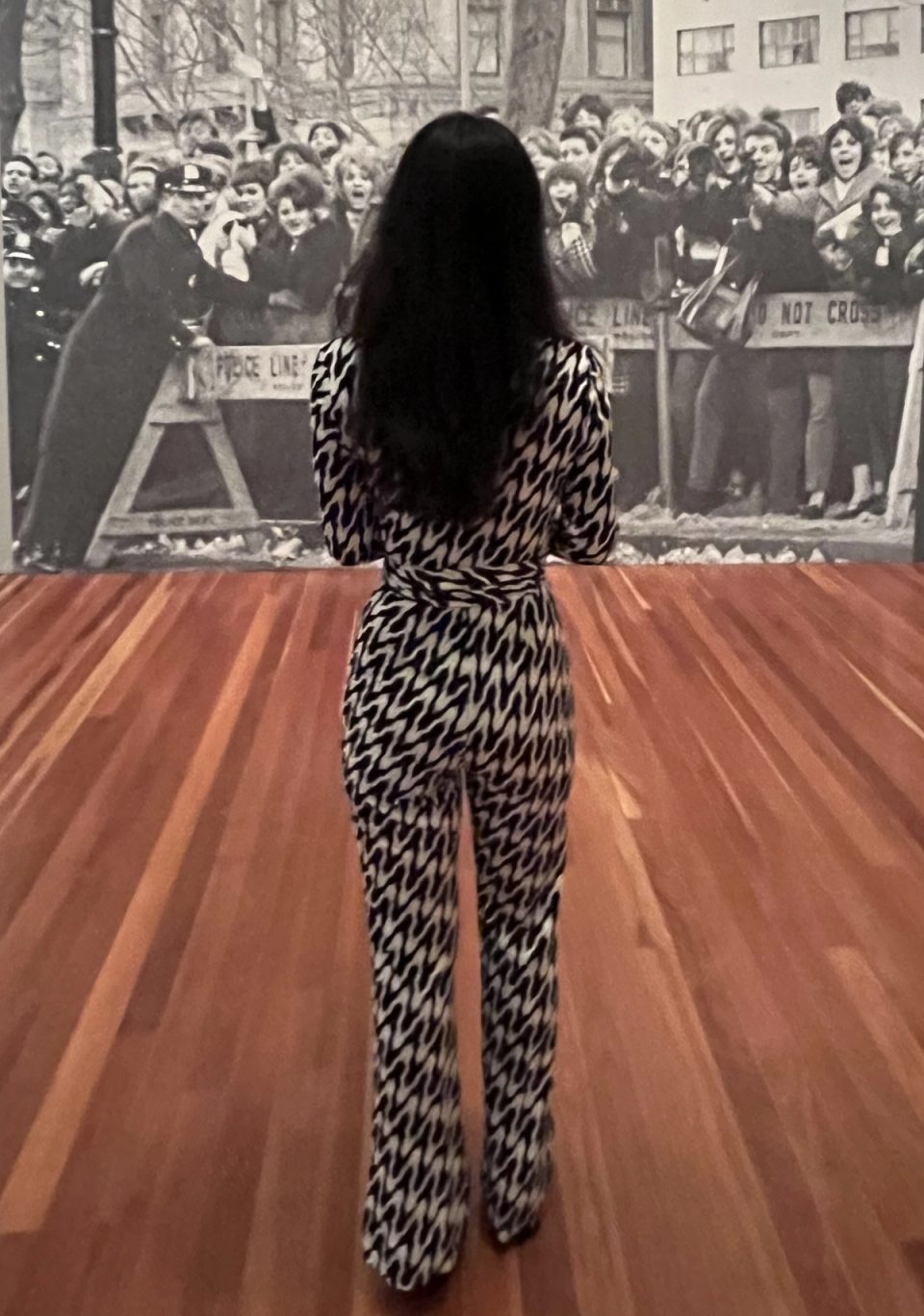
Also captured were historical moment of massive fans frantically await their arrivals, while refreshingly, everyday people such as policemen on streets and service people at hotels and airports, the connection to whom McCartney credits to his humble roots with an upbringing from a working-class family in Liverpool.
Additionally captured were well established professional photographers influenced by French new wave cinema, documentary filmmaking and photojournalism, Harry Benson, Dezo Hoffman and Robert Freeman, traveling with the Beatles and shooting the band’s each moves, as well as a photo of Astrid Kirchherr, a German photographer who is credited for influencing the Beatles’ “mop-top” hairstyle adoption, shooting the band at the set of A Hard Day’s Night, the Beatles’ 1964 musical comedy film that is credited as one of the most influential of all music films.
In front of the camera lens as a subject matter of the Beatlemania, a photo stands out of McCartney holding his daughter Mary with wife Linda standing behind, looking through the lens of a camera held in her hands. This photo is uniquely precious, capturing three photographers in one frame, Linda, the first woman to have her photograph featured on the Rolling Stone Magazine cover, and Mary, a future photographer and documentary filmmaker.
McCartney switched from black and white to color film once the Beatles arrived in Miami for a second appearance on The Ed Sullivan Show on February 16 1964. This time around they relaxed and had great fun like four big boys on vacation. Photographs of the Beatles swimming in the ocean, by the swimming
pool, on fishing boat and even a trip to the drive by movie depicted the innocent and playful side of the young men that were otherwise iconic superstars on stage.
The Beatles captured America’s heart in February 1964. It is especially nostalgic that after almost 60 years since their final concert at the Candlestick Park on August 29 1966, the Beatlemania returns to San Francisco with the exhibition of Paul McCartney Photographs 1963-64: Eyes of Storm, allowing many an opportunity to revisit the history of an extraordinary journey. Organized by the National Portrait Gallery, London and presented exclusively in California at the de Young Museum, March 1 to July 6, 2025.